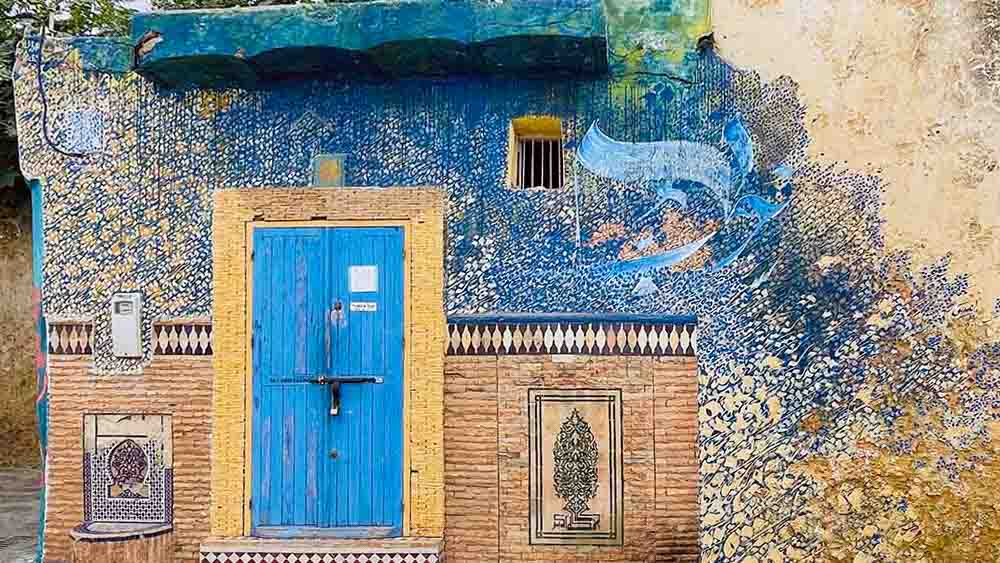
Whimsical street art in blue and gold colors on the outside of rustic art gallery in Asilah, Morocco.

Northern Morocco

Slow Travel Cultural Journey

March 19-28, 2026

Experience a relaxed pace in Tangier and Asilah, Morocco. Many cultures have influenced the creative spirit of both towns. Tangier is renowned for its rich history as a hub for writers and artists. Asilah, a peaceful seaside town, has recently become a center for vibrant creativity. Each place offers its own perspective, shaped by history and modern life.

Highlights

  • Tangier
    The storied city of Tangier has a multilayered history, beginning with the indigenous Amazigh people, the Phoenicians, the British, the Spanish, the Middle Eastern caliphates, and the French. During the 20th century, it was a creative and licentious playground for famous Western writers and artists. In the 21st century, Northern Moroccans reclaimed their status as a creative center. Ancient crafts are honored, colors abound, and local cuisine has found a home again. Northern Moroccan artisanship has a gentle rhythm and is reclaiming its history.
  • Asilah Medina
    Historical Asilah, with roots dating back to the Phoenicians in 1500 BC, is located on the Atlantic coast, 30 miles south of Tangier. While you walk the winding car-free streets of the whitewashed medina with the ancient Portuguese ramparts from the 1500s, you will see an abundance of lovely street art, art galleries, rug shops, and other craft shops. Peaceful walks in the Medina and along the ocean deepen your slow travel experiences.
  • Chefchaouen
    Chefchaouen, a charming blue-and-white village, is a tranquil place where you can sip fragrant mint tea and take as many beautiful pictures as you like. It was once known as the "Blue Pearl," painted blue by Jewish immigrants. Chefchaouen is a photographer's paradise with the blue buildings and sky, abundant art, rug shops, and peaceful cats. There are two squares in Chefchaouen, the larger one has the Kasbah Museum and attractive Andalusian-style gardens. The smaller square, Square El Haouta, is a quiet place to escape for tea or to try some Moroccan street food.
  • Learn to Make Zellige (Moroccan Tiles)
    Beautiful Zellige tiles emerged in Morocco in the 10th century. Zellige means "little polished tile" in Arabic. The terracotta tiles were carved into geometric shapes and assembled to form mathematical patterns with symbolic meaning. You can see them in palaces, fountains, and tombs in blue, green, yellow, white, and red colors. A local Asilah artist will teach you how to make a Zellige.

Cost

Price: $3524, based on double occupancy.

Contact us if interested. A deposit of $500 will hold your place. Credit cards are accepted

Fill out the registration form.

Read and sign Terms of Service

Activity Level

We walk 2-5 miles a day, typically over uneven surfaces, climb and descend stairs and steep hills sometimes. You may have to roll or carry your own luggage, possibly up and down stairs to your room. Please wear comfortable walking shoes. Sometimes, you may have to sleep near street noise. Bring ear plugs.

Odyssey Includes

  • * 9 nights lodging
  • * Train, bus, and vehicle transportaion
  • * All breakfasts, meals as indicated on itinerary
  • * Local bilingual guides, BBO staff
  • * Entrance fees to museums, archological sites

What is not included

  • * Round-trip airfare
  • * Travel insurance (recommended) that minimumly covers you for medical expenses including emergency repatriation.
  • * Alcoholic beverages at group meals
  • * optional activites/experiences
  • * meals not mentioned in the itinerary

Itinerary

Building on these rich influences, discover the cultural gems of northern Morocco at a slow pace with sustainable transportation; walking in the Medinas of Tangier and Asilah, and train travel between cities. The itinerary serves as a guideline of what is planned, but if you decide to have an afternoon or morning exploring or relaxing, you are encouraged to do so.

The day is flexible due to people arriving at different times, allowing time for those who want to rest before meeting for dinner. Those who arrive early or have lots of energy, will have a list of options to explore close to our lodging. Tangier sits at Africa's northern tip, only nine miles from Europe across the Strait of Gibraltar. The city offers beautiful views of both the Mediterranean and Atlantic. Tangier blends influences from Spanish, Arabic, Roman, Phoenician, and English cultures. These cultures have shaped the city's art and literature, attracting many famous international figures. To truly appreciate Tangier, slow down, feel it, and soak in the atmosphere. After you arrive at the Tangier international Airport and checked in, we will meet for dinner in the Medina. D

Many creative artists and writers felt a call to Tangier in the 19th and 20th centuries. Today, in a post-colonial era, the Moroccan people are reclaiming centuries-old creativity and crafts. We will explore layers of the ancient Kasbah on a guided walking tour, visiting the two main squares: Grand Socco and Petit Socco. B

We will take a day trip to Chefchaouen, a picturesque blue and white village nestled in the Rif Mountains. Here, you can enjoy mint tea and take plenty of photos. Known as the "Blue Pearl," the town was painted blue by Jewish immigrants. As you walk the narrow streets, please be respectful of the residents while taking photos. Chefchaouen has two main squares. The larger one features the Kasbah Museum and beautiful Andalusian-style gardens. Across the street, an old prison offers a rooftop view of the Medina. The smaller square, Square El Haouta, is a quiet spot to relax with a cup of mint tea or try some traditional Moroccan street food. Local shops offer a diverse selection of items, including rugs, art, and handmade crafts. B

After a relaxing breakfast, you will experience a slower day, giving you more time to explore on your own. You might revisit a shop you saw earlier, try speaking Moroccan Arabic with a local, or chat with shop owners. B

Take time to rest and recharge for the next 5 days. We will take a short train ride along the northwest Atlantic Coast from Tangier to Asilah, a peaceful and charming town. Asilah's architecture stands out, blending Arabic, Spanish, and Portuguese styles. You can wander the winding alleys of the Medina, built by the Portuguese centuries ago. We will stay in a beautiful riad in the medina with views of the Atlantic coast. When you arrive, you can stroll on the beach, read on the balcony, or watch the sunset. Gentle yoga or chair yoga will be offered daily on the riad's third floor balcony overlooking the Atlantic. B

Gentle yoga offered. The riad owner, will take us into the medina to introduce some of her favorite weavers and makers. She is a designer and writer who specializes in textiles and carpets. B

Gentle yoga offered. We will walk in the small Medina built by the Portuguese, with its green or blue doors leading to homes, shops, and riads. You will learn more about the meaning of colors in Morocco. Asilah is renowned for its vibrant murals, street art, galleries, sculptures, and craft shops. B

Start your day with chair yoga, followed by breakfast. Afterward, take part in a Zellige tile workshop led by a local craftsperson. Zellige is a decorative mosaic tile featuring geometric patterns and bright colors, first created in 10th-century Morocco to adorn mosques, palaces, and schools. B

Start the morning with chair yoga overlooking the Atlantic Ocean. This is your day to rest, wander the white washed alleys of Asilah, read, revisit select shops, write in your journal, etc. Dinner will be on the balcony overlooking the ocean, a time to share experiences and dreams. B

We will leave early in the morning for Tangier, a distance of approximately 20 miles. You can choose to have more time there or proceed on to your next destination. B